
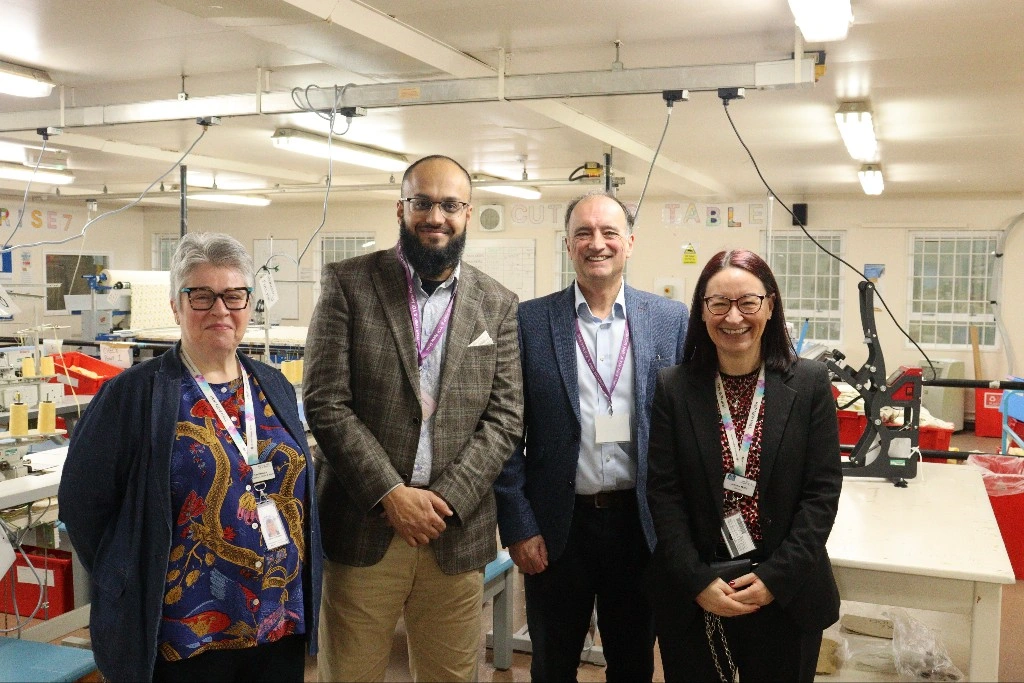
During National Apprenticeship Week, the Textile Centre of Excellence delivered a landmark Textiles Takeover day at HMP New Hall – an initiative aimed at supporting world-class meaningful prison education within prisons.
The aim was to show how industry can work with the prison service, where skills training meets real employer demand and when rehabilitation is approached with ambition rather than limitation.
A Unique Model for Industry and Justice Working Together
The Textile Centre of Excellence is an industry-owned, not-for-profit Group Training Association serving the fashion and textiles sector. Having trained more than 6,000 apprentices and 15,000 learners across specialist programmes – from Sewing Machinist and Garment Maker to Laboratory Technician and Textile Technical Specialist – the organisation brings genuine industrial credibility into every training environment it operates.
At HMP New Hall, that same industry standard is being delivered inside the prison estate. The programme follows a structured “triple-helix” approach:
- Logged hours on professional industrial machinery
- Clearly mapped progression routes
- Recognised certification aligned to employer needs
- Development of professional behaviours and workplace standards
- Wraparound charity and employer support to aid transition on release
This is training designed to lead directly to employment. By embedding employers into the process and ensuring certification holds weight beyond the prison gate, the Textile Centre of Excellence is establishing a replicable national model for prison-based, industry-led skills development.
Celebrating Achievement, Restoring Confidence
More than 35 women attended the celebration event, with seven learners achieving Bronze Awards and many more progressing towards Bronze and Silver recognition.
For many participants, this marked the first time their skills had been formally recognised to industry standards. The pride in the room was unmistakable – not only for the qualifications achieved, but for the confidence regained.
Shahban Aziz, Managing Director of the Textile Centre of Excellence, said:
“This initiative is about more than textiles. It is about restoring confidence, recognising achievement and creating hope.
When training is aligned to real industry demand and backed by employer engagement, it becomes transformational. Participants in this programme are demonstrating commitment, discipline and talent – and industry is responding with opportunity.”
The event was attended by Prison Governor Jennifer Willis, Head of Education, Skills and Work Sarah Fitzsimons, David Collinge of The Weavers’ Company, alongside Textile Centre of Excellence staff and employer partners – a visible show of cross-sector commitment.
David Collinge reflected:
“What a powerful example of partnership in action. I found this initiative at HMP New Hall genuinely inspiring.The combination of structured training, recognised certification and employer engagement reflects exactly the kind of joined-up thinking we need if we are serious about reducing reoffending and strengthening our communities. The opportunity to learn a practical, creative trade can transform confidence and self-belief.
Programmes like this do more than teach sewing – they restore hope, rebuild identity and open doors to a different future”.
Julia Roebuck, founder of Upcycle Fashion, added:
A while ago I read an article in Harper’s Bazaar by Nazanin Zaghari-Radcliffe. In an honest and deeply personal account, she shared her experience of sewing whilst in prison. Amidst the anger, sadness and frustration, the sewing room brought her moments of distraction, hope and connection. Universal moments for anyone who has found themselves lost in the concentration of a stitch.
I commend this initiative at HMP New Hall with TCoE working across their network to support textile skills development and employer connections.”
Leading the Future of Prison-Based Skills
Encouragingly, a significant number of participants have already enrolled onto further courses, creating clear onward progression. The Textile Centre of Excellence will continue working with employer partners to build sustainable employment routes and expand this model of delivery. By combining industrial rigour, recognised certification and coordinated support beyond release, the organisation is demonstrating how industry-led prison training can reduce barriers, rebuild identity and strengthen communities.